
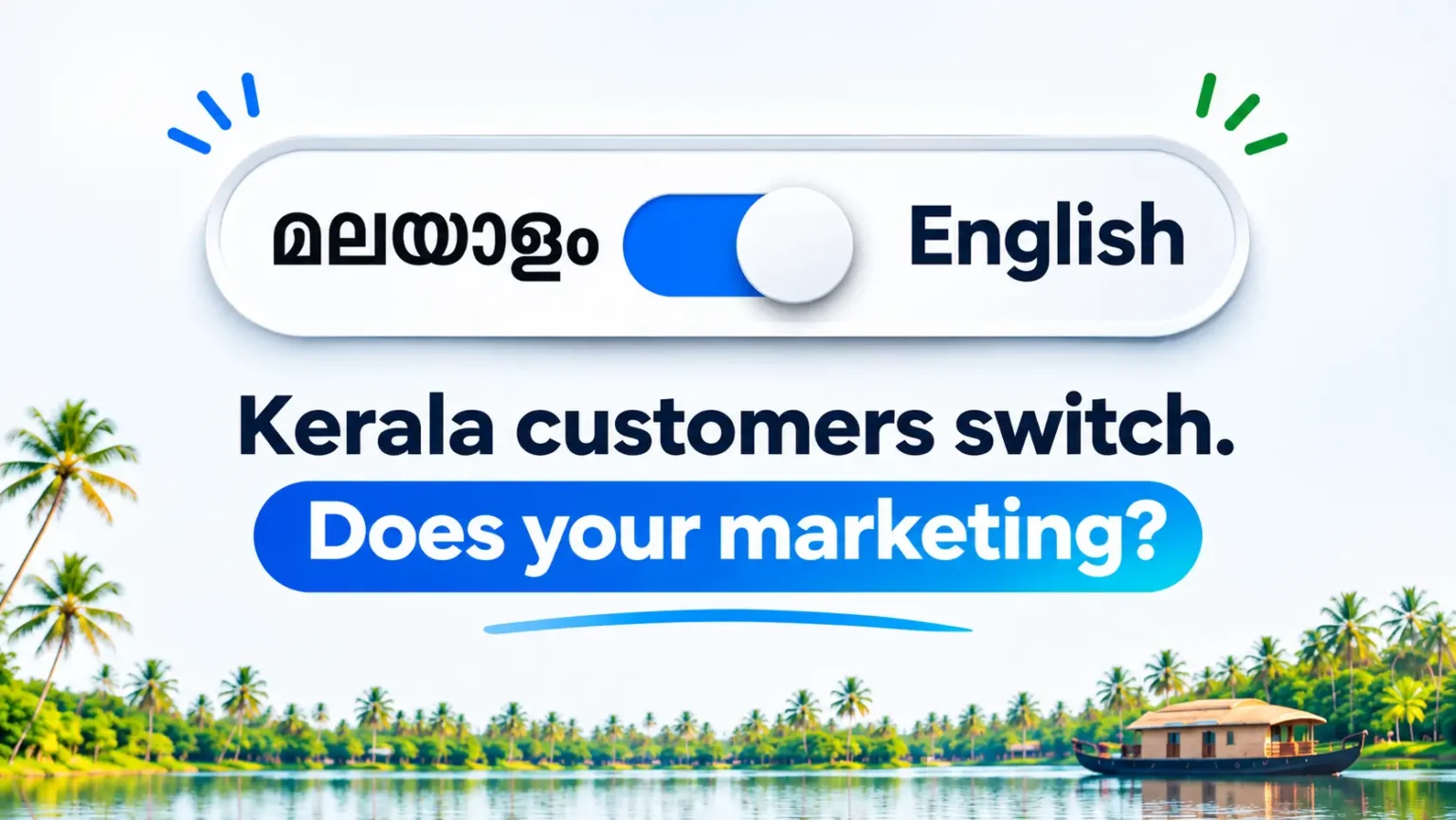

Why the language that wins attention in Kerala is not always the language that wins the enquiry.
A Malayalam Reel can get someone to stop scrolling in two seconds.
Getting that same person to enquire is a different job, and it often happens in a different language.


That gap is where a lot of Kerala marketing budgets quietly disappear.
Think about how people actually behave. Someone watches a Malayalam Reel about a dental treatment. They talk about it at home in Malayalam. Two days later, they open Google and type “best dental clinic near Kakkanad”. Or they type it in Malayalam script. Or they just ask their phone.
Those are different moments in the same journey. When a campaign treats them as one moment, money leaks.
I call this the Malayalam-First, English-Search Paradox. It is not a rule for every customer in Kerala. It is a pattern I think every marketer here should test before deciding where the budget goes.
The short version:
- People in Kerala often discover a business through Malayalam videos.
- When they are ready to compare or buy, they may search in English, Malayalam or Manglish.
- So use Malayalam content to get attention, make sure your website and Google listing show up for every kind of search, and track which one actually brings in enquiries.
Kerala is already online. That is not the question anymore.
The connectivity numbers are hard to argue with.
TRAI’s latest yearly performance report puts Kerala at about 98 internet subscriptions per 100 people as of March 2026, against a national figure of 76.59. One small note: this counts subscriptions, not unique people. Plenty of us carry two SIMs.
Data use keeps climbing too. The average Indian wireless user now consumes 25.51 GB a month, up from 21.53 GB a year earlier. That is a national number, but you do not need a Kerala-only figure to see the point.
Being online is no longer an advantage. Everyone is. The real question is what people do online, and in which language.
What people watch is not always how they search
Short video is where attention lives. The IAMAI-Kantar Internet in India Report 2025 counted 958 million active internet users in India, and 588 million of them (61%) watched short-video content during the year.
Language is where it gets interesting.
The 2024 edition of the same report found that 870 million Indians had used the internet in an Indian language such as Malayalam, Hindi or Tamil, and 57% of urban users said they prefer content in Indian languages. But look at what they were doing in those languages. Watching videos came in at around 81%. Online search was around 19%.
The report also found that Malayalam, along with Tamil and Telugu, is one of the languages where people lean most strongly towards using the internet in their own language.
So people clearly love consuming content in Malayalam. Searching in it is a different story.
I want to be honest about the limit here. These figures do not tell us what language people type into Google, and they are not Kerala-specific. What they do show is that language use changes with the activity. That is enough to question both the “Malayalam everywhere” and the “English everywhere” approach. It is not enough to replace your own data.
One customer, three languages
Go back to that dental clinic in Kakkanad.
The customer discovers it through a Malayalam Reel. It feels familiar and easy to follow, almost like a friend explaining it.
But when they start comparing options, their searches could look like this:
- best dental clinic near Kakkanad
- dentist in Kochi
- കാക്കനാട് ഡെന്റൽ ക്ലിനിക്
- kakkanad dentist near me
Same person. English, Malayalam script and Manglish, sometimes in the same afternoon.
Google has said that most of its users in India use more than one language, and that the share of Indians using voice search every day is nearly double the global average. Its search is being built to handle exactly this mix.
So the lesson is not “Kerala searches in English”. The lesson is to find out how your customers actually search, instead of deciding it in advance.
Where the budget quietly leaks
When businesses treat language as an either-or choice, I see three problems come up again and again.
1. English ads for a Malayalam-first audience. The video is polished and the message is correct. But it misses the conversational feel that makes someone stop and listen. I will not claim English ads always cost more, because CPM (what you pay each time your ad is shown 1,000 times) also depends on competition, audience size, placements and creative quality. The point is to test whether the language fits the audience, not to assume it.
2. Malayalam Reels with nothing behind them. The views come in and awareness grows. Then someone searches for the business and finds very little. No clear service page, no reviews, no pricing, a half-filled Google Business Profile. That is attention without being easy to find, and it often ends up helping a competitor close the sale. If your profile needs work, this Google Business Profile optimization checklist is a good place to start.
3. Judging video on the last click. Someone watches your Reel today, Googles you tomorrow and fills a form next week. Most reports give all the credit to the last thing a person clicked before enquiring, which here is the search. The video gets none. Cut the video based on that report, and you may be cutting the very thing that created the search.
How I would build a bilingual campaign
I would not translate every ad into two languages. I would give each language a clear job, then let the data confirm or correct that decision.
Step 1: Use conversational Malayalam to earn attention
For Meta Reels and YouTube Shorts, start with natural, spoken Malayalam. It should sound like a real conversation, not an English script read out in translation.
Formats that usually work well:
- Explaining a common customer problem
- Answering the questions people ask you every week
- Showing how your product or service actually works
- Clearing up a misconception in your industry
- Sharing real customer stories
In some industries, English subtitles or familiar English terms help people follow along without losing the Malayalam feel.
The goal here is familiarity and trust, not just views. In social media marketing, this is the stage where language choice makes the biggest difference.
Step 2: Capture intent in the languages people really search in
This is where SEO and Google Ads take over.
Before choosing a language, look at real search behaviour. Three places to start:
- Google Search Console for the queries already bringing people to your site
- Google Keyword Planner for search volume and variations
- The search terms report in Google Ads for what people typed before clicking your ad
Look for patterns across English queries, Malayalam-script searches, Manglish and location-based searches. A business in Kochi, for example, should know how people search for its service alongside areas like Kakkanad, Edappally or Vyttila.
Then build pages that answer those searches properly: service details, pricing where it makes sense, local proof, reviews, FAQs and an easy way to enquire. This kind of local search mapping sits at the heart of SEO for Kerala businesses. And if you run Google Ads campaigns, the search terms report is often where the language surprises show up first.
The aim is not an English-only website. It is making sure you can be found and understood, however the customer searches.
Step 3: Connect the attention to real enquiries
This is the step most campaigns skip.
Retarget the people who actually watched. Retargeting simply means showing a follow-up ad to people who have already seen your content. Meta lets you build audiences based on how much of a video someone watched, from casual viewers to people who watched most of it. The option names change from time to time, so check what Ads Manager shows you. Then test a second ad with a clearer call to action. Just remember that a long view shows interest, not purchase intent, so measure the retargeting results instead of assuming.
Watch your branded searches. In Google Search Console, check how often your business appears and gets clicked when people search for your business name. If branded searches rise while your Malayalam videos are running, that is a good sign. It is not proof, though. Seasons, offline activity and other campaigns can move that number too.
Measure enquiries, not applause. Add UTM parameters, small tags that tell Google Analytics where each visitor came from, to every campaign link (a UTM link generator makes this painless), set up conversion tracking in GA4 (Google Analytics 4) so you can see which visits turn into enquiries, and record every lead in a CRM, or even a simple spreadsheet if you are just starting. Then judge campaigns on:
- Cost per lead
- Lead quality
- Qualified enquiries
- Cost per qualified lead
- Conversion rate
Views and likes tell you the content is being seen. These numbers tell you whether it is working for the business. To see how the credit shifts between channels, you can run your figures through this marketing ROI and attribution calculator.
The one test I would run first
Instead of debating Malayalam versus English, test it.
Keep the objective, audience, offer, placements and budget the same. Make two comparable ads and change only the language. Then compare:
| Metric | What it tells you |
|---|---|
| CPM | What it costs to reach the audience |
| Video watch time | Whether the creative holds attention |
| Engagement rate | Whether people interact with it |
| CTR (click-through rate) | How many people who saw the ad clicked on it |
| Cost per lead | What each enquiry costs you |
| Qualified lead rate | Whether those enquiries are worth anything |
Give the test enough time and budget to mean something. A decision based on a handful of clicks is just a guess with a spreadsheet attached.
And follow it all the way to the lead. The ad with more views is not always the ad that brings in more customers.
The takeaway
Kerala’s audience cannot be reduced to Malayalam versus English.
People here are multilingual. They might discover you through a Malayalam Reel, compare you using English keywords, read reviews in both languages and finally message you on WhatsApp. That is not confusing behavior. It is simply how multilingual people use the internet.
Our job as marketers is to plan for those switches instead of ignoring them.
Use the language that earns attention. Understand the language people use to search. Measure what actually brings in business.
If you want a second opinion on how this applies to your own business, that is the kind of work I do as a digital marketer in Kerala.
Quick answers
Should my ads be in Malayalam or English?
If most of your customers speak Malayalam, start your Reels and Shorts in Malayalam, then test an English version against it. Let the cost per enquiry decide, not the number of views.
Do people in Kerala search on Google in Malayalam?
Some do. Many search in English or Manglish, and voice search is common in India. Your Google Search Console data and the Google Ads search terms report will show you how your own customers search.
I run a small business. Where should I start?
Start with the basics: a complete Google Business Profile and a clear website page for each service. Then add Malayalam videos to build awareness, and use UTM links so you can see which posts and ads bring in enquiries.