

Creating and verifying a Google Business Profile is only the beginning. To make it useful, you need to keep your business information accurate, choose the right categories, add relevant photos, manage reviews, maintain your website information and check how customers interact with your profile.
- Google Business Profile Optimization Checklist: Start Here
- 1. Claim, Verify and Secure the Correct Profile
- 2. Choose the Right Primary and Additional Categories
- 3. Complete the Business Information Accurately
- 4. Add Useful, Genuine Photos and Videos
- 5. Manage Reviews Honestly and Professionally
- 6. Review Services, Products and Posts
- 7. Check for Duplicate Profiles, Ownership Problems and Policy Violations
- 8. Strengthen the Website and Local SEO
- 9. Understand Local SEO, AEO and GEO
- 10. Track Performance and Customer Actions
- 11. Use the Google Business Profile Optimization Checklist Spreadsheet
- Final Thoughts
- 12. Frequently Asked Questions
This guide takes you through the process step by step. We’ll look at what to check, why it matters and how to improve it, with examples for different types of businesses. You can follow the checklist on this page or use the accompanying spreadsheet to record your progress.
Google Business Profile Optimization Checklist: Start Here
Before getting into the details, go through this quick checklist. It will help you identify the areas that need attention.
| Area | What to check |
|---|---|
| Profile access and verification | Make sure the correct business profile is claimed, verified where required and managed by the right people. |
| Business name | Use the genuine business name without adding unnecessary keywords. |
| Primary category | Choose the most accurate category for the business’s main activity. |
| Additional categories | Add only categories that describe other genuine business activities. |
| Business information | Check the address, phone number, website, opening hours and description. |
| Services and products | Add accurate information about the offerings, wherever these features are available. |
| Photos and videos | Use clear, genuine visuals that represent the actual business. |
| Reviews | Encourage honest feedback and respond professionally. |
| Posts and updates | Keep announcements, events and offers accurate and current. |
| Duplicate profiles | Identify duplicate listings and resolve ownership issues. |
| Policy compliance | Review profile notices, eligibility and restrictions. |
| Website and local SEO | Check business information, relevant directories, location pages and structured data. |
| AEO and GEO | Make business information clear and consistent across relevant sources. |
| Performance | Review available profile metrics, website visits and enquiries. |
| Maintenance | Record changes and schedule regular reviews. |
You don’t have to complete everything at once. Start with the most important issues, such as incorrect business information, profile access problems, duplicate listings and policy notices. Then work through the remaining items.
1. Claim, Verify and Secure the Correct Profile
The first step is to confirm that you’re working with the correct profile. If you skip this step, you could end up updating a duplicate listing or spending time on a profile that you don’t properly control.
Search for the business name on Google Search and Google Maps. Check whether a profile already exists before creating another one.
What should you check?
- Confirm that the profile represents the correct business and location.
- Claim the profile if it is not already managed by an authorized person.
- Complete Google’s verification process when required.
- Check that the correct owners and managers have access.
- Review any verification notices, restrictions or other profile issues.
Which verification methods are available?
Google may offer different verification methods depending on the business, profile and account. These can include phone or text, email, video recording, live video call or mail. The available options are determined by Google, so you cannot necessarily choose whichever method you prefer.
Follow the instructions shown in your profile. You can refer to Google’s current business verification guidance if you need help.
Here’s a personal example. My first Google Business Profile was verified using a code delivered by post while I was staying in a hostel. That was my experience at the time. Verification processes have changed over the years, so don’t assume that the same method will be available for every business today.
One important point: Verification doesn’t mean the profile is fully optimized. It confirms that the required verification process has been completed. You still need to review the information, categories, photos, services and other areas covered in this guide.
2. Choose the Right Primary and Additional Categories
Categories tell Google what your business does and help connect the profile with relevant searches. This is one area you should review carefully rather than selecting categories just because competitors use them.
Primary category
Choose the most specific available category that accurately describes the business’s main activity.
For example, a bakery that mainly sells baked goods should select an appropriate bakery category rather than a broad category that describes its business less accurately.
A more specific category can help Google understand what the business primarily offers. You can read Google’s guidance on managing business categories.
Additional categories
Additional categories are useful when they describe other genuine business activities.
For example, a business that operates as both a bakery and a café may qualify for relevant categories for both activities, depending on how it actually operates and which categories Google provides.
However, a bakery shouldn’t add unrelated categories simply to target more keywords. Your categories should reflect what your business genuinely does.
How can you research competitors’ categories?
You can start by searching for comparable businesses on Google Maps and noting the categories shown on their profiles. Third-party tools such as GMB Everywhere may also help with category research and profile comparisons.
Treat these tools as research aids. A competitor’s category choices aren’t automatically right for your business because the services, operations and eligibility may differ.
Category checklist
- The primary category accurately describes the main business activity.
- Additional categories are relevant and justified.
- The categories match the services actually offered.
- Comparable businesses have been reviewed for research.
- Unrelated categories haven’t been added just to target extra keywords.
3. Complete the Business Information Accurately
Once the categories are in place, review the business information. Customers should be able to understand what you offer, where you operate and how to contact you without having to search multiple websites.
Business name
Use the name your business genuinely uses in the real world. Don’t add location names, services, slogans or keywords unless they are genuinely part of the business name and comply with Google’s guidelines.
For example, use the actual business name of a bakery rather than adding a phrase such as “Best Cakes in Kochi” simply to influence search results.
Address and service areas
If customers visit your business, check that the address is accurate and that your business meets Google’s requirements for displaying it.
If you travel to customers instead, configure the service area according to the areas you genuinely serve and Google’s current rules. Don’t create fake offices or use an address that doesn’t qualify.
Phone number and website
Check that the phone number connects to the correct business and that the website link opens the intended page.
For example, if you have moved your shop, update the address on the profile and review the website and other important listings for outdated information.
Opening hours
Review your regular opening hours, including differences between weekdays and weekends. Add special hours for holidays or temporary closures when needed.
For example, if your shop normally closes at 6 p.m. but will close at 2 p.m. on a festival day, update the special hours so customers don’t arrive when the business is closed.
Business description
Explain what the business does in clear, accurate language.
For example:
“A family-run bakery offering custom cakes, pastries and fresh bread.”
This tells customers more than a list of disconnected keywords. Keep the description factual and avoid unsupported claims such as “the best bakery in Kerala.”
Business information checklist
- The business name is accurate.
- The address and map pin are correct, where applicable.
- Service areas are appropriate, where applicable.
- The phone number and website work.
- Regular and special hours are correct.
- The description clearly explains the business.
- Booking and other action links work, where available.
4. Add Useful, Genuine Photos and Videos
Photos help customers understand what a business looks like, what it offers and what they can expect before visiting or making contact.
The goal isn’t to upload as many images as possible. The goal is to show genuine, relevant visuals that help people make a decision.
What photos should you add?
The right selection depends on the business type.
| Business type | Useful visual content |
|---|---|
| Clinic | Exterior and entrance, reception, waiting area, facilities and relevant team photographs, while respecting privacy and consent requirements. |
| Bakery | Shop exterior, display counter, baked products, custom cakes and the actual customer-facing environment. |
| Catering business | Food presentation, buffet arrangements, menu examples and event setups. |
| Event management business | Event layouts, stage setups, decorations and examples of completed events, with appropriate permissions. |
| Retail shop | Storefront, interior, product displays and the range of products available. |
| Professional service | Office or consultation environment, team photographs and other genuine visuals that help customers understand the service. |
For example, a bakery can show photographs of its actual cakes and display counter. A clinic can show its reception and facilities, but it should not publish identifiable patient photographs without the necessary permission.
Avoid using stock images as though they represent your actual premises or products. Photos should give customers a realistic idea of what to expect.
What about videos?
Videos can help demonstrate a location, product, service or business environment. For example, a short walk-through of a shop or a completed event can give customers a better understanding of the business.
Use videos where they add value and follow Google’s current photo, video and post content policies.
Also review the logo and cover image where these options are available. Keep them appropriate and recognizable, remembering that Google may not always display a selected cover image exactly as you expect.
Photos and videos checklist
- The logo and cover image are appropriate, where available.
- Photos represent the actual business.
- Images show relevant products, services, facilities or work.
- Photos are clear and not misleading.
- Videos are relevant and comply with current requirements.
- Permissions and privacy requirements are respected.
- New visuals are added when the business or its offerings change.
5. Manage Reviews Honestly and Professionally
Reviews can influence how potential customers perceive your business. They also provide feedback that can help you identify problems and improve your service.
The focus should be on getting genuine feedback, not simply trying to increase the rating.
How can you encourage genuine reviews?
You can ask customers to share honest feedback after a real interaction or purchase. Make the process easy by using Google’s review link or QR code options.
Don’t buy reviews, create fake reviews or offer discounts, gifts or other incentives in exchange for reviews. Google also prohibits selectively soliciting only positive reviews and discouraging negative feedback. You can check the current Google review guidelines.
A simple request could be:
Thank you for choosing us. If you have a moment, we’d appreciate an honest review of your experience. Your feedback helps us understand what we’re doing well and where we can improve.
How should you respond to positive reviews?
Acknowledge the customer’s feedback without repeating the same generic sentence every time.
For example:
Thank you for sharing your experience. We’re glad you were happy with the service and appreciate you taking the time to leave feedback.
If the customer mentions a specific service or product, you can acknowledge that detail naturally.
How should you respond to negative reviews?
Avoid arguments, accusations or attempts to disclose private customer information. Acknowledge the concern, remain professional and offer an appropriate way to continue the conversation privately.
For example:
Thank you for bringing this to our attention. We’re sorry to hear that your experience did not meet expectations. Please contact our team directly so we can understand the issue and review it properly.
Don’t assume every negative review is genuine, but don’t assume it is false simply because it is unfavorable. If a review appears to violate Google’s policies, use the official reporting process.
Reviews checklist
- A permitted process exists for requesting genuine reviews.
- Customers aren’t offered incentives for reviews.
- Reviews are monitored regularly.
- Responses are professional and relevant.
- Private information isn’t disclosed.
- Potential policy-violating reviews are handled through Google’s process.
- Customer feedback is used to identify recurring service issues.
6. Review Services, Products and Posts
Depending on your business category and the features available, Google Business Profile may allow you to display services, products, posts and other information.
Use these features to help customers understand what you actually offer.
Services and products
Add relevant services or products where supported. Use clear names and accurate descriptions, and keep the information aligned with your website and actual offerings.
For example, a bakery might list custom cakes and pastries, a catering business might explain its event catering services, and a clinic might describe relevant services it provides.
Don’t list services you don’t offer simply to target more searches.
Posts and updates
Posts can communicate useful information, such as business announcements, events, seasonal updates, product changes and offers that comply with Google’s policies.
For example, a bakery could share an update about its holiday opening hours, while an event management business could post about a completed event.
Keep information accurate, avoid expired offers and check links before publishing. Posts are useful for communicating with customers, but publishing them frequently shouldn’t be treated as a guaranteed way to improve rankings.
Services and posts checklist
- Relevant services and products are listed, where supported.
- Names and descriptions are accurate.
- Booking or action links work, where available.
- Posts contain useful, current information.
- Expired offers and outdated updates are reviewed.
- Content follows Google’s current policies.
7. Check for Duplicate Profiles, Ownership Problems and Policy Violations
A business may have more than one profile because of an old listing, a previous owner, an accidental duplicate or a change in business details.
Duplicate profiles can confuse customers and create management problems. Before creating a new profile, search for existing listings and resolve ownership issues through Google’s official process.
What should you review?
- Look for duplicate profiles representing the same business.
- Confirm that the correct person or organization controls the profile.
- Check whether the business name, address or other details have changed.
- Review profile notices, warnings or restrictions.
- Confirm that each profile represents a genuine eligible business or location.
- Avoid creating separate profiles for locations or operations that don’t meet Google’s requirements.
If a profile is suspended or restricted, read the relevant policy and follow Google’s instructions for resolving the issue. Don’t create another profile to bypass a suspension.
An incomplete profile isn’t automatically a policy violation. A profile can need optimization without being suspended, and a completed profile can still have an eligibility or policy issue.
Example: Suppose a shop has moved to another address and someone creates a second profile without resolving the old one. Customers may see conflicting information. The correct approach is to review the existing listing and follow Google’s process for managing the business’s details, rather than automatically creating more profiles.
8. Strengthen the Website and Local SEO
Google Business Profile shouldn’t be managed in isolation. Your website and other reliable sources should provide consistent, useful information about the business.
Local SEO helps search engines understand the business’s relevance to local searches, its location and the information available about it.
Google identifies three main factors in local ranking: relevance, distance and prominence. Relevance is how well a business matches a search, distance relates to how far it is from the searcher, and prominence relates to how well-known it is. You can’t control every factor, particularly a searcher’s distance from the business. Read Google’s explanation of how to improve local ranking.
Keep business information consistent
Review the business name, address and phone number across important sources, including the website and relevant directories.
For example, if your business has moved, update important listings that still display the old address. Consistency helps prevent confusion, but it doesn’t guarantee higher rankings.
Create useful location pages
If a business genuinely serves multiple locations, create location pages where they help customers. Each page should contain meaningful, location-specific information.
A useful location page may include the actual address and contact details, opening hours, services available at that location, relevant photos, directions or a map, and answers to common questions.
For example, a business with two genuine branches may need separate pages describing each branch. Creating many nearly identical pages that differ only by city name doesn’t provide the same value.
The same principle applies to regional service pages. For example, a page about SEO services in Kerala should help readers understand the services and regional context, rather than simply repeat location keywords.
Use LocalBusiness structured data where appropriate
LocalBusiness structured data can help search engines interpret information about a local business when it is implemented correctly.
The markup should match the visible content on the page, use the appropriate type and follow Google’s LocalBusiness structured data guidance.
For example, if the page shows the business’s name, address and opening hours, the structured data should accurately represent those details. Structured data doesn’t guarantee a rich result or higher ranking, and it can’t compensate for inaccurate website content.
Connect related website pages
Internal links help users navigate between related information. A general service page can link to a relevant location page, while a location page can link to the services actually available there.
Website and local SEO checklist
- The website link in the profile works.
- Important business information is accurate on the website.
- Relevant directory listings have been reviewed.
- Location pages provide useful, unique information where needed.
- LocalBusiness structured data is used where appropriate.
- Structured data matches visible page content.
- Relevant internal links connect related pages.
- No fake locations or misleading location pages have been created.
9. Understand Local SEO, AEO and GEO
You may have come across terms such as Local SEO, AEO and GEO. They are related, but they don’t mean exactly the same thing.
Local SEO
Local SEO focuses on helping a business appear in relevant local search results, including Google Search and Google Maps.
Accurate business details, appropriate categories, useful website content and a well-maintained profile all contribute to a useful local presence. Google also considers relevance, distance and prominence when determining local results.
AEO: Answer Engine Optimization
AEO focuses on making information easy for answer-oriented systems to understand and use when responding to questions.
For a local business, this means clearly explaining what it does, which services it offers, where it operates and how customers can contact it.
For example, if a customer wants to know whether a catering business serves a particular area, clear service descriptions and location information make it easier to understand what the business offers.
GEO: Generative Engine Optimization
GEO refers to making information useful and understandable to generative AI systems that produce answers and summaries.
For a local business, this may involve maintaining accurate information across its website and profile, publishing useful content and explaining services and locations clearly.
One important point: AEO and GEO shouldn’t be treated as secret techniques that replace SEO. Google’s guidance on optimizing websites for generative AI features explains that established SEO best practices remain relevant to its generative search features. It also emphasizes useful, original content rather than attempts to manipulate AI responses.
The same principle applies here: make the information helpful and accurate first, instead of creating content only because you want an AI tool to mention your business.
How might this work in practice?
Imagine someone is searching for a bakery nearby that makes custom birthday cakes.
- Google Search and Maps: The person may see local businesses, profile details, reviews, directions, photographs and website links, depending on the search and available results.
- Google Gemini: The person may receive an AI-generated response based on information available to the system, potentially including relevant search information and other sources.
- ChatGPT Search: The person may receive a summarized answer with links to sources that support the response.
These systems don’t necessarily use identical information or return the same businesses. Results can vary by query, location, available sources and product features. You can learn more about Google Gemini and ChatGPT Search.
A well-maintained Google Business Profile can help make business information available in Google’s ecosystem, but it doesn’t guarantee that a business will be recommended by Gemini or ChatGPT. AI systems may use information from websites and other sources, and visibility can change over time.
What should a business do?
- Describe services in clear, natural language.
- Keep business information accurate and consistent.
- Create useful pages that answer genuine customer questions.
- Make contact details and location information easy to find.
- Maintain relevant, trustworthy information on the website.
- Check how the business appears for realistic customer queries.
- Treat AI visibility as something to observe and improve, not a promised outcome.
If you come across a term you don’t understand, use the glossary. This link is a placeholder for a dedicated glossary page that can be added later.
10. Track Performance and Customer Actions
Optimization should be reviewed against actual outcomes rather than assumptions about what might improve rankings.
Google Business Profile provides performance information for eligible profiles, although the available metrics and reporting periods can vary. Depending on the profile and reporting interface, useful metrics may include profile views, searches, calls, website clicks, directions and other interactions.
You can review the available data using Google’s guide to Business Profile performance.
| Metric | What it helps you understand |
|---|---|
| Profile views or visibility metrics | How often the profile is shown or viewed under the available reporting definitions. |
| Search information | What people searched for when discovering the profile, where reported. |
| Website clicks | Recorded interactions that led people to the website. |
| Calls | Call-button clicks reported by the profile; these may not equal answered calls or qualified leads. |
| Direction requests | Reported requests for directions, which don’t necessarily prove a visit occurred. |
| Website enquiries | Enquiries recorded through forms, calls or other website conversion tracking. |
| Completed leads or sales | Business outcomes that can be confirmed through the business’s own records. |
Use UTM parameters where appropriate
UTM parameters can help distinguish website traffic arriving from a Google Business Profile link in analytics tools such as Google Analytics 4.
For example, a website link may use campaign parameters such as utm_source, utm_medium and utm_campaign. Choose a consistent naming convention, test the link and check that analytics records the expected traffic.
UTM tracking helps with website attribution. It doesn’t measure every interaction within Google Maps, and it can’t prove that someone who clicked a website link became a customer without suitable conversion tracking.
Establish a review routine
Record the date of each major change and compare performance over consistent periods. Consider seasonality, changes in business demand, competing businesses and other factors before attributing a change to one edit.
For example, if website clicks increase after updating the profile, record that change and compare the results with a consistent earlier period. Don’t assume that one edit caused the entire increase without considering other possible explanations.
Performance checklist
- Available profile performance metrics are recorded.
- Reporting dates and comparison periods are consistent.
- Website traffic from the profile is tracked where appropriate.
- Enquiries and completed business outcomes are distinguished from clicks.
- Major changes are documented.
- The profile is reviewed again after meaningful changes.
11. Use the Google Business Profile Optimization Checklist Spreadsheet
The checklist in this article helps you understand what to review. If you want to work through the tasks over time, the accompanying spreadsheet helps you record progress, organize priorities and keep track of follow-up actions.
I’ve also included a checklist poster below so you can keep the key tasks handy. You can download or save the poster for quick reference, or click the poster to open the Google Sheets checklist and make your own copy. The original spreadsheet is view-only, so you’ll need to create your own copy in Google Drive to edit task statuses, record notes and track your progress.
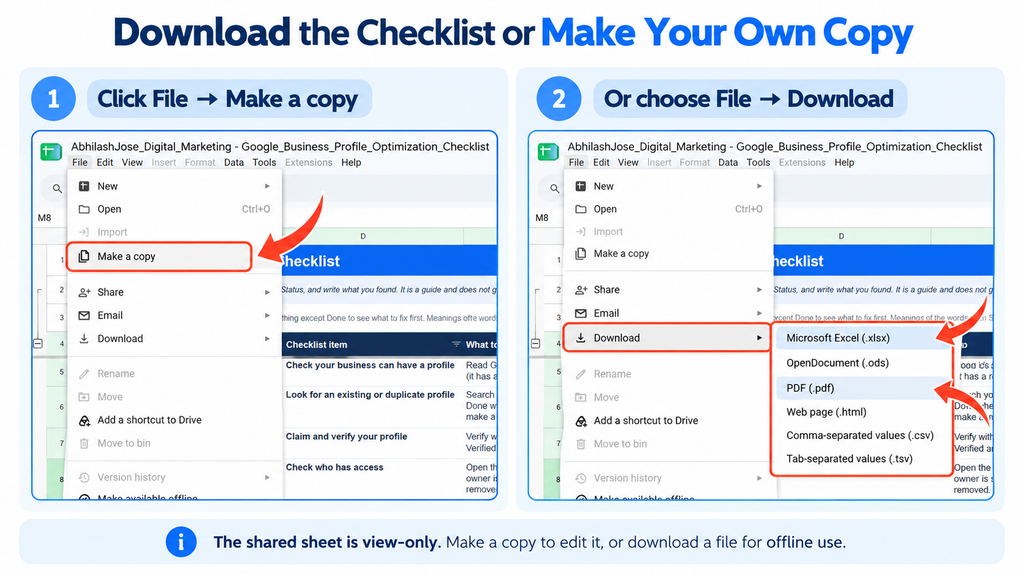
Open the Google Business Profile Optimization Checklist and make your own copy
What does each spreadsheet tab contain?
- Start Here: Read the workbook instructions, progress overview and explanations of what each tab contains.
- Master Checklist: Track tasks, priorities, statuses and follow-up actions, for example correcting business hours or reviewing categories.
- Business Details: Record important profile information, for example the business name, address, phone number, hours and website.
- Content & Reviews: Review photos, services, posts and reviews, for example checking whether a bakery’s photos show its actual products.
- Website & Local SEO: Check website details, local information and supporting pages, for example confirming that a location page contains the correct address and opening hours.
- AEO & GEO: Review the clarity and consistency of information for answer-oriented and generative systems, for example checking how clearly the business explains its services and service area.
- Performance Log: Record metrics and changes over time, for example comparing website clicks and calls across consistent reporting periods.
- Multiple Locations: Organize checks for eligible businesses with more than one location, for example two genuine branches in different towns.
- Resources & Change Log: Keep reference links and a record of updates.
You don’t need to complete every task in one sitting. Start with the high-priority issues, record what needs fixing and revisit the remaining tasks in a planned order.
Final Thoughts
Google Business Profile optimization is an ongoing process, not a one-time setup task. A profile can be verified and still contain outdated information, irrelevant categories, incomplete services, unhelpful photos or unresolved policy issues.
Start by reviewing the essentials: eligibility, access, business details and categories. Then improve the information customers see, manage reviews responsibly, check your website and supporting local information, and measure the interactions that matter to the business.
Local SEO, AEO and GEO can overlap, but they shouldn’t be treated as interchangeable or as guaranteed ranking strategies. The practical goal is to make business information accurate, useful and easy for people and search systems to understand.
Use the checklist one section at a time. Record what is complete, what needs attention and what should be reviewed again. If you’re looking for help with your broader search visibility and website optimization, explore my SEO services.
12. Frequently Asked Questions
Is creating and verifying a Google Business Profile enough?
No. Creating and verifying a profile establishes its presence and completes the required verification process. Optimization also involves accurate information, appropriate categories, relevant visuals, reviews, services, policy compliance, website consistency and ongoing measurement.
How often should a Google Business Profile be optimized?
There is no universal schedule. Review the profile whenever business information changes, such as opening hours, contact details, services or location. A periodic audit can help identify outdated information and unresolved issues. More frequent reviews may be appropriate for businesses that change their offerings or opening hours regularly
Do Google Business Profile posts improve rankings?
Posts can communicate useful updates and help customers understand current offerings. However, publishing posts is not a guaranteed ranking improvement. Keep posts accurate and useful rather than publishing frequently just to meet an arbitrary quota.
Do more Google reviews guarantee higher rankings?
No. Reviews can help potential customers evaluate a business, and Google’s local ranking guidance notes that reviews and ratings can contribute to prominence. However, more reviews don’t guarantee a higher position. Avoid buying reviews or manipulating feedback.
Should I add every possible business category?
No. Choose the most accurate primary category and relevant additional categories that genuinely describe the business. Irrelevant categories can misrepresent the business and create policy risks.
Does adding Local Business structured data guarantee local rankings?
No. Structured data can help search engines understand information on a website, but correct implementation doesn’t guarantee a particular ranking or rich result. It should support accurate, useful website content.
Does Google Business Profile optimization guarantee visibility in ChatGPT or Gemini?
No. Maintaining accurate business information and useful website content can support discoverability, but AI-generated answers depend on the systems, available sources, query and other factors. There is no guaranteed method for getting a business mentioned in every AI answer.
Can I edit the Google Sheets checklist directly?
The shared original is view-only. Use the make-a-copy link to create an editable version in your own Google Drive.
What should I fix first during a Google Business Profile audit?
Start with eligibility, access and verification issues, inaccurate business details, incorrect categories, duplicate profiles and policy notices. Then review services, visuals, reviews, website consistency, local SEO and measurement. Prioritize according to the actual problem rather than trying to complete every item in the same order for every business.